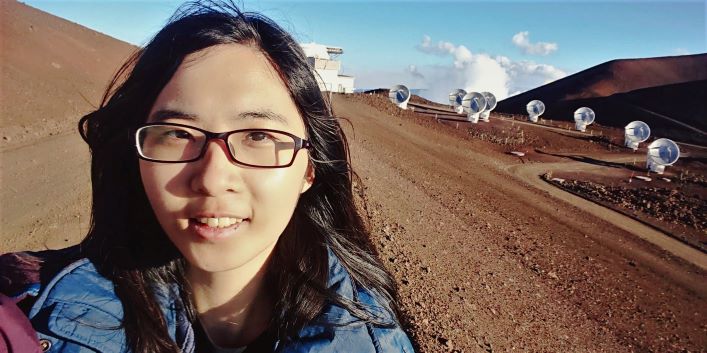
Hi! I’m Yu-Hsuan (Eltha) Teng.
I am currently a postdoctoral research associate in the Astronomy Department at University of Maryland. Previously, I received my Ph.D. in Physics from University of California San Diego. I also received my Master’s in Physics and B.S. in Electrical Engineering from National Taiwan University. I am broadly interested in star formation, interstellar medium, galactic nuclei, and how they altogether shape the large-scale galactic environment that drives galaxy evolution.
My research aims to understand the baryon cycle and the evolution of galaxies, which are largely driven by the rise and fall of star formation activities in galaxies. Specifically, I have been studying molecular gas and star formation in nearby galaxies, using state-of-the-art telescopes such as the Atacama Large Millimeter/submillimeter Array (ALMA), James Webb Space Telescope (JWST), and the Green Bank Telescope (GBT).
To establish a solid foundation for molecular gas measurements, I have worked extensively on understanding the physics of the CO-to-H2 conversion factor (αCO), which is a key parameter for inferring molecular gas (H2) masses from CO observations. Based on accurate molecular gas measurements, my research then expands into large sample of galaxies across different evolutionary stages, aiming to probe how star formation grows within the active galaxies, and how star formation get quenched in the quiescent galaxies. To this end, I have:
[1] established the modeling and techniques for measuring molecular gas properties and αCO with multi-line CO isotopologue observations (Teng et al. 2022);
[2] identified the physical drivers and key observables for tracing αCO variations in barred galaxy centers (Teng et al. 2023);
[3] developed a new αCO prescription that can be applied across large galaxy samples, which further reveals a systematically enhanced star formation efficiency in active barred galaxy centers (Teng et al. 2024);
[4] published resolved αCO maps for thousands of local galaxies, including most of the modern galaxy surveys (Sun, Teng et al. 2025);
[5] uncovered that galaxy quenching can be primarily driven by inefficient gas consumption rather than a lack of gas, particularly for the deeper quenching process into fully retired galaxies (Teng et al. 2026).
I also study dense gas environment and massive star formation, targeting molecular clouds in both our Galaxy and nearby galaxies. In particular, my master thesis focused on the dense, star-forming filaments in Orion Molecular Cloud-1, which is the nearest high-mass star-forming region in our Galaxy (Teng & Hirano 2020). To learn more about my research, please go to my projects or publications.
Contact me: yhteng at umd.edu